


Small Language Models (SLMs): Why the Future of AI is Tiny and Offline
- Suraj Kumar

- Dec 2, 2025
- 3 min read
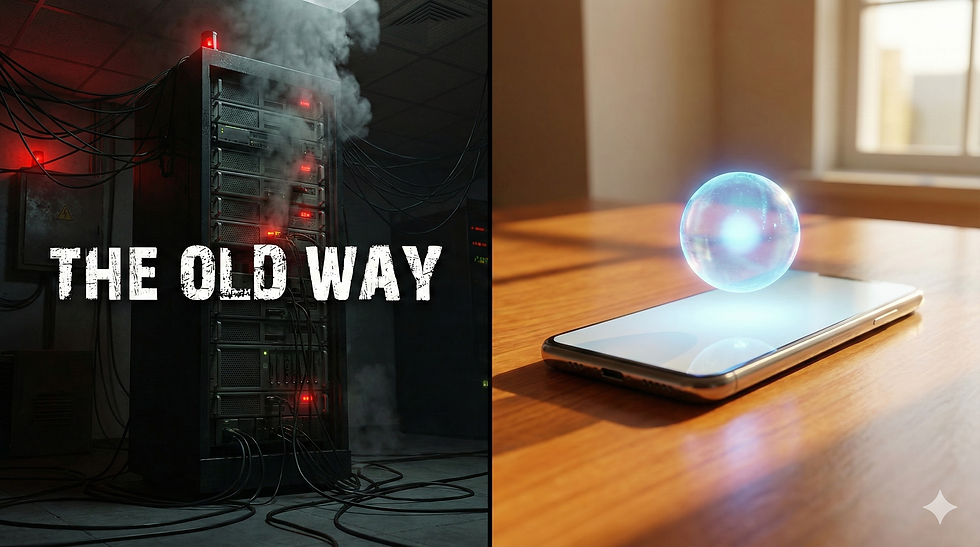
The Dinosaur in the Server Room
For the last three years, we have been obsessed with "bigger is better." We watched GPT-3 turn into GPT-4, and Gemini turn into Ultra, treating parameter counts like high scores in a video game.
We collectively bought into the idea that for an AI to be smart, it had to be a massive, energy-guzzling brain living in a server farm in Northern Virginia.
But in 2025, that narrative is collapsing. While the media is still hyperventilating about AGI (Artificial General Intelligence), the engineers actually building products have quietly pivoted.
They aren't trying to fit a god-like supercomputer into your pocket anymore. They are building "Small Language Models" (SLMs), which are tiny, efficient, and surprisingly capable AIs that live right on your device.
The future of AI isn't a bigger cloud. It's a smarter edge. And honestly? It’s about time.
The "Shadow AI" Problem (Or: Why Your Boss is Panicking)
To understand why SLMs are exploding, you have to look at the corporate nightmares of 2024.
Remember the Samsung incident? Engineers pasted proprietary code into ChatGPT to fix a bug, and poof—that secret code became part of OpenAI’s training data. That wasn't a glitch; it was a feature of the cloud-based model.
This created the "Shadow AI" crisis. Employees were using authorized AI tools in secret to do their jobs, leaking sensitive data in the process. CIOs were left with a terrible choice: ban AI and fall behind, or allow AI and risk corporate espionage.
SLMs solve this instantly. A model like Mistral 7B or Google’s Gemma can run entirely on a laptop, disconnected from the internet. Your data never leaves the building. It’s the difference between working in a glasshouse and working in a bunker.

Size Doesn't Matter (If You Are Specialized) for a Small Language Model
The biggest misconception is that small models are "dumb." If you ask a 3-billion-parameter model to write a Shakespearean sonnet about quantum physics, it will struggle. But that’s not what we use AI for 99% of the time. We use it to summarize emails, autocomplete code, or extract data from PDFs.
Microsoft’s Phi-3 proved that a tiny model trained on textbook-quality data could outperform massive models on reasoning tasks. It turns out, if you don't train your AI on Reddit comments and conspiracy theories, you don't need trillion-parameter brains to be smart.
We are entering the era of the Specialist AI. Instead of one General Practitioner trying to know everything, we will have a team of Specialists:
A tiny model on your phone that only knows how to schedule meetings.
A local model in your IDE that only knows Python.
A secure model in your HR software that only knows labor laws.

The Latency Killer: Why "Offline" is a Feature
Have you ever tried to use a voice assistant in a basement with bad reception?
"I'm sorry, I'm having trouble connecting to the internet."
In 2025, that sentence is unacceptable. Cloud AI has a "speed of light" problem. Your voice has to travel to a server, get processed, and come back. That 500ms delay is why talking to Alexa still feels like talking to a walkie-talkie, not a person.
SLMs run locally. The latency is near-zero. This is unlocking the "Agentic Future" we were promised. If you want an AI agent to navigate your phone, open apps, and book a ride, it can't be waiting for a cloud server to approve every click. It needs to live on the silicon in your pocket.
Apple knows this. Their entire "Apple Intelligence" strategy is built around on-device processing. They aren't doing it just for privacy; they are doing it because it makes the product feel snappy.

Conclusion: The pendulum swings back
We are watching the pendulum swing from centralization (The Cloud) back to decentralization (The Edge).
For developers, this is a massive opportunity. You no longer need an API key and a credit card to build AI features. You can download Ollama, pull a model, and build a fully private, offline AI app for free.
The dinosaurs in the server rooms aren't going extinct, but they are about to get a lot of tiny, fast, and agile company.


Comments